Tuesday, August 7, 2012

Quality Manual


Quality Manual

What is thier experience with writing the QA Manual?
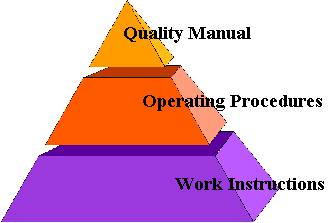
Your ISO 9001 Quality Manual is the top tier document for your Quality Management system (QMS).

Write the Quality Manual so a customer can read it. Many customers will ask for a copy of the manual. They want to ensure that you have addressed all the critical quality management systems. If there are product complaints, customers may refer to your manual to understand your quality systems.

Quality professionals are known for creating documentation. Has the interviewee created or updated a Quality Manual? What standard was the manual based on? Common answers to this are ISO 9001, TS 16949, Mil-Q, Mil- I, ISO 14001 and AS 9100. Can they provide an example?
Who approved the manual? This lets you know that others reviewed the manual and believed the manual was appropriate to their business. If there was no approval process then the interviewee skipped key steps for setting up the Quality system. 
  • http://www.quality-assurance-solutions.com/images/ISO-9001-quality-manual2.jpgDesignate the list of the key procedures
  • Describe the Scope
  • Outline your document structure
  • Justify any exclusions.
  • Document the Quality Policy
  • Process Interaction Chart
  • State who is the management representative


Scope

The scope of the manual describes why the manual is written. In case of ISO 9001, the scope could be:

The policies written within this manual conform to ISO 9001. The manual supports our company scope of making widgets. The manual describes the quality management systems deployed at our company.
Only clauses from product realization can be excluded from your quality management system. For example Customer Property Control does not apply to many companies
So If there is a section from product realization that does not apply to your business, you can take exclusion to this in the manual. Provide a justification on the exclusion within the QA manual. During a ISO 9001 audit, the auditor will need verbal reasoning for the exclusion.

ISO 9001 Main and Key Elements


ISO 9001 Main and Key Elements

ISO 9001 Definition: Quality Management System key elements- Section-4
Management Responsibility key elements Section-5
Resource Management key elements Section-6
  • Training and Competency
  • Infrastructure
  • Work Environment
Product Realization key elements Section-7
  • http://www.quality-assurance-solutions.com/images/ISO-9001-Definition2.jpgPlanning
  • Product requirements determination
  • Product requirements review
  • Customer communication
  • Design and Development planning, inputs, outputs, review, verification and validation
  • Controlling Design and Development changes
  • Purchasing process
  • Purchasing information control
  • Purchase Product Verification
  • Process validation for production and service
  • Identification and traceability
  • Customer property control
  • Preservation of Product
  • Control of monitoring and measuring equipment
Measurement Analysis and Improvement key Elements Section-8


ISO 9001:2008 Quality management systems— Requirements

ISO 9001:2008 Quality management systems — Requirements is a document of approximately 30 pages which is available from the national standards organization in each country. It is supplemented by two other standards: ISO 9000:2005 Quality management systems — Fundamentals and vocabulary and ISO 9004:2009 Managing for the sustained success of an organization — A quality management approach. Only ISO 9001 is directly audited against for third party assessment purposes. The other two standards are supplementary and contain deeper information on how to sustain and improve quality management systems; they are therefore not used directly during third party assessment. Outline contents for ISO 9001 are as follows:
  • Page iv: Foreword
  • Pages v to vii: Section 0 Intro
  • Pages 1 to 14: Requirements
    • Section 1: Scope
    • Section 2: Normative Reference
    • Section 3: Terms and definitions (specific to ISO 9001, not specified in ISO 9000)
    • Section 4: Quality Management System
    • Section 5: Management Responsibility
    • Section 6: Resource Management
    • Section 7: Product Realization
    • Section 8: Measurement, analysis and improvement
  • Pages 15 to 22: Tables of Correspondence between ISO 9001 and other standards
  • Page 23: Bibliography
Before the certification body can issue or renew a certificate, the auditor must be satisfied that the company being assessed has implemented the requirements of sections 4 to 8. Sections 1 to 3 are not directly audited against, but because they provide context and definitions for the rest of the standard, their contents must be taken into account.
The standard specifies that the organisation shall issue and maintain the following six documented procedures:
  • Control of Documents (4.2.3)
  • Control of Records (4.2.4)
  • Internal Audits (8.2.2)
  • Control of Nonconforming Product / Service (8.3)
  • Corrective Action (8.5.2)
  • Preventive Action (8.5.3)
In addition to these procedures, ISO 9001:2008 requires the organization to document any other procedures required for its effective operation. The standard also requires the organisation to issue and communicate a documented quality policy, a Quality Manual (which may or may not include the documented procedures) and numerous records, as specified throughout the standard.